Festival Introduction
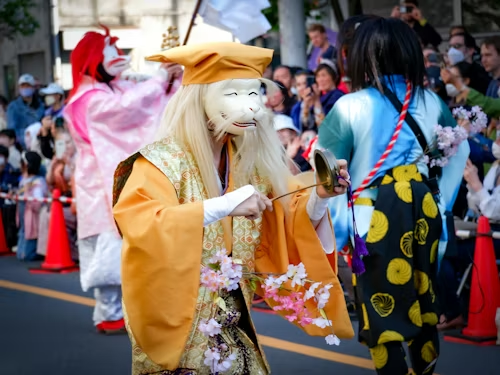
Japanese festivals, known as "matsuri," represent the vibrant heart of Japanese cultural expression, serving as living bridges between ancient traditions and contemporary community life. These celebrations encompass thousands of years of cultural evolution, blending Shinto religious practices, Buddhist influences, and seasonal agricultural cycles into spectacular displays of community unity, artistic expression, and spiritual devotion. Each festival carries deep cultural significance that extends far beyond entertainment, functioning as essential mechanisms for cultural transmission, social cohesion, and spiritual renewal that continue to play vital roles in modern Japanese society.
The diversity of Japanese festivals reflects the country's rich regional variations and historical complexity, with each prefecture, city, and neighborhood maintaining unique traditions that have been passed down through generations. From intimate local shrine celebrations involving a few dozen participants to massive urban spectacles attracting millions of visitors, Japanese festivals demonstrate the remarkable adaptability of traditional culture to changing social circumstances while maintaining their essential spiritual and community functions.
Understanding Japanese festivals requires appreciating their multifaceted nature as religious ceremonies, cultural performances, social gatherings, and economic activities that simultaneously honor deities, celebrate seasonal changes, strengthen community bonds, and preserve traditional arts and crafts. This complexity makes festivals invaluable windows into Japanese culture, providing insights into values, beliefs, and social structures that might not be apparent through other cultural expressions or tourist attractions.
Participation and Timing
Understanding Festival Participation Etiquette
Participating respectfully in Japanese festivals requires understanding the delicate balance between religious observance, community celebration, and cultural preservation that characterizes these events. Visitors should approach festivals with appropriate reverence for their spiritual significance while appreciating their role as community celebrations that welcome respectful participation from outsiders. This balance requires cultural sensitivity, advance preparation, and willingness to follow local customs and guidance from festival organizers and community members.
Proper festival attire demonstrates respect for cultural traditions while enhancing your experience through appropriate participation in festival activities. Traditional clothing like yukata (summer kimono) or jinbei (casual summer wear) is often welcomed and sometimes required for certain activities, though modest Western clothing is generally acceptable for observers. Many festivals offer rental services for traditional clothing, providing opportunities for deeper cultural engagement while supporting local businesses and cultural preservation efforts.
Photography and documentation during festivals require sensitivity to religious elements and community privacy expectations. While most festivals welcome photography of public performances and displays, certain religious ceremonies or private community moments may be off-limits to cameras. Always ask permission before photographing individuals, respect barriers and designated areas, and be mindful that your documentation should enhance rather than disrupt the festival experience for participants and other visitors.
Seasonal Festival Calendar and Planning
Japanese festivals follow complex calendars that combine lunar cycles, agricultural seasons, and historical commemorations, creating year-round opportunities for cultural engagement that reflect different aspects of Japanese life and values. Spring festivals celebrate renewal and agricultural beginnings, summer festivals provide community gathering during the growing season, autumn festivals give thanks for harvests and prepare for winter, while winter festivals mark spiritual reflection and preparation for the new year cycle.
Planning festival attendance requires understanding that dates may vary between lunar and solar calendars, with some festivals occurring on fixed dates while others shift annually based on traditional calculations. Major festivals like Gion Matsuri in Kyoto or Awa Odori in Tokushima require advance planning for accommodation and transportation, while smaller local festivals may offer more spontaneous participation opportunities but require local knowledge to discover and access.
Regional festival concentrations create opportunities for festival tourism that combines multiple cultural experiences within manageable travel itineraries. Certain regions like Tohoku or Kyushu offer particularly rich festival traditions, while urban areas like Tokyo and Osaka provide convenient access to diverse festival types throughout the year. Understanding these patterns helps travelers plan trips that maximize authentic cultural experiences while respecting local communities and festival traditions.
Major Festivals
Gion Matsuri: Kyoto's Crown Jewel
Gion Matsuri, held throughout July in Kyoto, represents one of Japan's most prestigious and historically significant festivals, dating back over 1,150 years to its origins as a purification ritual to appease the gods during a plague epidemic. This month-long celebration culminates in the spectacular Yamaboko Junko procession, featuring elaborate floats (yamaboko) that are considered moving museums of traditional Japanese craftsmanship, textiles, and artistic expression. Each float represents centuries of community investment, artistic development, and cultural preservation that demonstrates the deep connections between religious devotion, artistic excellence, and community pride.
The festival's cultural significance extends beyond its religious origins to encompass its role in preserving traditional crafts, music, and performance arts that might otherwise disappear in modern Japan. The preparation process involves entire neighborhoods in months of planning, fundraising, and skill development that strengthens community bonds while transmitting cultural knowledge to younger generations. Visitors can observe this preparation process through neighborhood visits, craft demonstrations, and educational programs that provide insights into the complex social and cultural systems that sustain traditional Japanese festivals.
Gion Matsuri's international recognition has made it a model for cultural tourism that balances preservation with accessibility, demonstrating how traditional festivals can welcome global audiences while maintaining their authentic character and community significance. The festival's success in managing tourism pressure while preserving cultural integrity offers valuable lessons for other cultural heritage sites and traditional celebrations facing similar challenges from globalization and mass tourism.
Awa Odori: Tokushima's Dancing Spirit
Awa Odori in Tokushima represents Japan's largest traditional dance festival, transforming the entire city into a stage for one of the country's most accessible and participatory cultural celebrations. This 400-year-old festival embodies the Japanese concept of "fool's dance" where participants embrace joyful abandon while maintaining precise choreographic traditions that require years of practice to master. The festival's motto, "It's a fool who dances and a fool who watches, so if both are fools, you might as well dance," captures the democratic spirit that makes Awa Odori uniquely welcoming to participants of all skill levels and cultural backgrounds.
The festival's organization into "ren" (dance groups) creates opportunities for visitors to participate in structured learning experiences that provide authentic cultural engagement while respecting traditional forms and community hierarchies. Many ren welcome international participants through workshops, practice sessions, and performance opportunities that offer insights into Japanese approaches to group harmony, artistic discipline, and cultural transmission. These experiences provide deeper cultural understanding than passive observation while contributing to the festival's continued vitality and evolution.
Awa Odori's influence on Japanese popular culture and its adaptation to modern contexts demonstrate how traditional festivals can evolve while maintaining their essential character and cultural significance. The dance form has spread throughout Japan and internationally, creating global communities of practitioners who maintain connections to Tokushima while adapting the tradition to diverse cultural contexts. This global reach illustrates how authentic cultural traditions can transcend their original boundaries while preserving their core values and practices.
Nebuta Matsuri: Aomori's Illuminated Giants
Nebuta Matsuri in Aomori showcases spectacular illuminated floats that combine traditional craftsmanship with dramatic storytelling, creating one of Japan's most visually stunning festival experiences. These massive paper and bamboo sculptures, some reaching five meters in height, depict historical and mythological figures through intricate designs that require master craftsmen and months of preparation. The festival's origins in ancient purification rituals have evolved into a celebration of artistic achievement and community collaboration that demonstrates the creative potential of traditional Japanese festival culture.
The festival's participatory elements, including the energetic "haneto" dancers who accompany the floats, create opportunities for visitors to engage actively in the celebration while learning traditional dance movements and festival customs. The haneto tradition welcomes participants who wear proper costumes and follow basic etiquette, providing accessible entry points for cultural engagement that respect traditional forms while encouraging enthusiastic participation. This balance between tradition and accessibility makes Nebuta Matsuri an excellent introduction to Japanese festival culture for international visitors.
The festival's economic and cultural impact on Aomori demonstrates how traditional celebrations can serve as engines for regional development while preserving cultural heritage and community identity. The months of preparation, the influx of visitors, and the year-round cultural programs associated with Nebuta create sustainable economic benefits that support traditional crafts, cultural education, and community development initiatives. This model illustrates how cultural preservation and economic development can work together to strengthen communities while sharing cultural treasures with global audiences.
Regional Variations and Local Specialties
Tohoku Region: Resilience and Renewal
The Tohoku region's festivals reflect the area's history of natural challenges and community resilience, creating celebrations that emphasize collective strength, spiritual renewal, and connection to natural forces. Festivals like Sendai Tanabata and Akita Kanto demonstrate how traditional celebrations can provide emotional and spiritual resources for communities facing adversity while maintaining cultural continuity across generations. These festivals gained additional significance following the 2011 earthquake and tsunami, serving as symbols of recovery and community determination that inspire both participants and observers.
Tohoku festivals often incorporate elements that reflect the region's agricultural heritage and relationship with natural cycles, creating celebrations that honor both human achievement and natural forces. The region's harsh winters and dramatic seasonal changes influence festival timing and themes, resulting in celebrations that mark important transitions and provide community gathering opportunities during challenging periods. These festivals offer insights into how traditional culture can provide stability and meaning during times of change and uncertainty.
The region's festival traditions have adapted to modern circumstances while maintaining their essential character and community functions, demonstrating the resilience and adaptability of Japanese cultural practices. Post-disaster recovery efforts have strengthened festival traditions by highlighting their importance for community cohesion and cultural identity, creating renewed appreciation for traditional celebrations among younger generations who might otherwise be drawn to more modern forms of entertainment and social engagement.
Kansai Region: Historical Depth and Artistic Refinement
Kansai region festivals reflect the area's role as Japan's historical and cultural heartland, featuring celebrations that showcase centuries of artistic development, religious tradition, and cultural refinement. Festivals in Kyoto, Osaka, and Nara demonstrate the sophisticated integration of religious observance, artistic expression, and social ceremony that characterizes traditional Japanese high culture. These celebrations often feature elaborate costumes, complex musical performances, and refined ceremonial elements that require extensive training and cultural knowledge to execute properly.
The region's festivals serve as living museums of traditional Japanese arts, preserving performance techniques, craft skills, and cultural knowledge that might otherwise be lost to modernization. Many festivals feature demonstrations, workshops, and educational programs that make these traditional arts accessible to contemporary audiences while maintaining their authentic character and cultural significance. These educational elements provide valuable opportunities for cultural learning that extend beyond entertainment to encompass serious cultural engagement and appreciation.
Kansai festivals often incorporate elements that reflect the region's role in Japanese Buddhism and Shinto development, creating celebrations that provide insights into the religious and philosophical foundations of Japanese culture. Temple and shrine festivals in this region offer particularly authentic experiences of Japanese religious practice, allowing visitors to observe and sometimes participate in ceremonies that have remained largely unchanged for centuries. These experiences provide rare opportunities to engage with living religious traditions in their historical contexts.
Modern Adaptations and Contemporary Relevance
Urban Festival Evolution
Modern Japanese cities have adapted traditional festival formats to contemporary urban environments, creating hybrid celebrations that maintain cultural authenticity while accommodating modern infrastructure, safety requirements, and diverse populations. Urban festivals like Tokyo's Kanda Matsuri and Osaka's Tenjin Matsuri demonstrate how traditional celebrations can thrive in metropolitan settings by adapting their scale, timing, and logistics while preserving their essential cultural and spiritual elements. These adaptations provide models for cultural preservation in rapidly changing urban environments.
Technology integration in modern festivals enhances rather than replaces traditional elements, using lighting, sound systems, and digital communication to improve safety, accessibility, and cultural education without compromising authentic cultural expression. Many festivals now offer multilingual information, digital guides, and virtual reality experiences that make traditional culture more accessible to international visitors while providing educational resources for younger Japanese generations who may be less familiar with traditional cultural practices.
Contemporary festival management balances cultural preservation with practical considerations like crowd control, environmental impact, and economic sustainability, creating professional organizational structures that support traditional community leadership while ensuring successful event execution. These hybrid management approaches demonstrate how traditional cultural practices can adapt to modern requirements while maintaining their community-centered character and cultural authenticity.
Youth Engagement and Cultural Transmission
Modern Japanese festivals face challenges in engaging younger generations who may be more attracted to contemporary entertainment forms than traditional cultural practices. Successful festivals have developed innovative approaches to youth engagement that combine traditional elements with modern appeal, creating entry points for cultural participation that respect traditional forms while acknowledging contemporary interests and communication styles. These approaches often involve social media integration, contemporary music elements, and youth leadership opportunities that provide meaningful roles for younger participants.
Educational programs associated with festivals have evolved to include school partnerships, international exchange programs, and digital learning resources that make traditional culture relevant and accessible to contemporary students. These programs often combine hands-on craft instruction, performance training, and cultural history education to provide comprehensive understanding of festival traditions and their contemporary significance. Such educational initiatives ensure cultural continuity while adapting traditional knowledge transmission methods to modern learning preferences and technologies.
Youth participation in festival organization and leadership provides opportunities for cultural learning that extend beyond performance or attendance to encompass the complex social, organizational, and cultural skills required to maintain traditional celebrations. These leadership experiences often become transformative cultural education that creates lifelong commitments to cultural preservation and community engagement, ensuring that traditional festivals continue to evolve and thrive in contemporary Japanese society.
Conclusion
Japanese festivals represent living expressions of cultural continuity that demonstrate how traditional practices can remain vibrant and relevant in contemporary society while preserving their essential character and community significance. These celebrations offer invaluable opportunities for cultural understanding that extend far beyond entertainment to encompass spiritual experience, artistic appreciation, and community engagement that can profoundly impact visitors' understanding of Japanese culture and their own cultural perspectives and values.
The diversity and accessibility of Japanese festivals ensure that every visitor can find celebrations that match their interests, comfort levels, and cultural curiosity, whether seeking intimate spiritual experiences, spectacular artistic displays, or participatory community celebrations. This variety reflects the richness and complexity of Japanese culture while providing multiple entry points for cultural engagement that can accommodate different learning styles, cultural backgrounds, and personal preferences.
Participating respectfully in Japanese festivals requires preparation, cultural sensitivity, and openness to experiences that may challenge preconceptions about Japanese society and traditional culture. The rewards of such participation include not only memorable experiences but also deeper understanding of how traditional cultures can maintain their vitality and relevance while adapting to changing circumstances and global influences.
The lessons learned from Japanese festival culture extend beyond Japan to offer insights into cultural preservation, community building, and the integration of tradition with modernity that can inform cultural development efforts worldwide. These festivals demonstrate that cultural authenticity and contemporary relevance are not mutually exclusive but can be combined through thoughtful adaptation and community commitment to cultural values and practices.
For travelers seeking authentic cultural experiences, Japanese festivals provide unparalleled opportunities to engage with living traditions that continue to play vital roles in contemporary Japanese society. These experiences offer perspectives on community, spirituality, and cultural expression that can enrich understanding of both Japanese culture and the universal human needs for celebration, community connection, and cultural meaning that festivals address across all cultures and societies.
Ready to experience Japan's incredible festival culture? Explore our comprehensive guides to festival etiquette and participation, seasonal celebration calendars, or regional festival specialties that will help you plan meaningful cultural encounters. Japanese festivals offer windows into the soul of Japanese culture that can transform your understanding of this remarkable nation and its enduring cultural traditions.